
 Street Marketing & Experiential
Food Marketing & Influencer Strategy: The Tantie Case Study Ahead of 2027 Trends
Millions of views and an engaged community of over 5,000 followers: with ICS Agency, Tantie launched its African food brand by leveraging culinary influence and community marketing. Discover how, and what its success signals for 2027 food industry trends.
Antonio Huerta
8 min read
18Table of Contents
- Why launching a food brand is a unique challenge in 2026
- A consumer arbitrating purely by price
- A vast yet impersonal "world cuisines" aisle
- The Tantie launch: concepts crafted at the heart of the African community
- Culinary creators from within the community
- Street-level content and cultural resonance
- Results: a loyal and highly engaged community
- What the Tantie case study signals for 2027 food marketing trends
- 1. Authority shifts from brands to creators
- 2. Growth comes from communities, not generic mass markets
- 3. Engagement is the ultimate brand armor
- 4. Retail availability becomes a primary marketing mandate
- 5. Generative AI models become everyday shopping advisors
- How to launch a food brand in 2027
- Key Takeaways
- Executive Summary
- Frequently Asked Questions (FAQ)
- Referenced Sources
A food brand launching today must earn its place in an increasingly pressurized industry. The French agri-food sector brings together roughly 20,000 businesses and 520,000 employees generating €250 billion in turnover, yet its net profit margin caps at 3.5%—compared to 5.8% across broader manufacturing—and one in four companies operates at a loss (ANIA, January 2026). At the same time, 52% of French consumers state that social media directly influences their eating habits (OpinionWay for SIAL Paris, April 2026). This is the exact environment where Tantie, an authentic African food brand (coconut milk, plantain chips, chili puree, gari), launched alongside ICS Agency in December 2025. Within months, the brand accumulated millions of views across TikTok and Instagram, rallied a loyal community of over 5,000 engaged followers, and achieved engagement rates surpassing legacy market competitors. Here is a food marketing case study showing how culinary influence and community-first strategy allow a challenger brand to thrive—and what it signals for 2027 food trends.
Why launching a food brand is a unique challenge in 2026
A consumer arbitrating purely by price
The FMCG market is expanding, but it offers zero leeway to new entrants. Fast-moving consumer goods sales hit a record €140 billion in 2025, while promotional deals accounted for 21.9% of sales—their highest share in two decades (NielsenIQ, February 2026). Over the first four months of 2026, private label volumes grew by approximately 2.2%, whereas national brands contracted by 0.2% (Circana via FranceAgriMer). Furthermore, 53% of French consumers report they are willing to switch food brands for a better promotional offer (BCG, June 2026). For an emerging brand with no prior supermarket shelf history, the only sustainable defense is genuine consumer brand preference.
A vast yet impersonal "world cuisines" aisle
World food aisles account for approximately €5.2 billion in French supermarkets, propelled by younger generations, international travel, and the surge in ethnic fast-casual dining (Xerfi, 2026). Tantie’s primary audience is the African diaspora: in 2024, INSEE recorded 1.42 million immigrants and 1.20 million descendants of immigrants from Sub-Saharan Africa (INSEE). Yet, the competitive audit conducted by ICS revealed that most brands in this aisle rarely communicate; those that do rely predominantly on generic brand content and annual trade fairs (ICS campaign review). In such a quiet market, taking an authentic voice is already a decisive advantage.
The Tantie launch: concepts crafted at the heart of the African community
The core objective set in December 2025 was clear: build brand awareness and establish an authentic online showcase for the product lineup. Rather than broadcasting generic posts, ICS designed several complementary storytelling concepts, each fulfilling a strategic role in the marketing funnel: brand discovery, product consideration, and community engagement. The common thread: staying deeply rooted in African culture, traditional recipes, and authentic stories.
Culinary creators from within the community
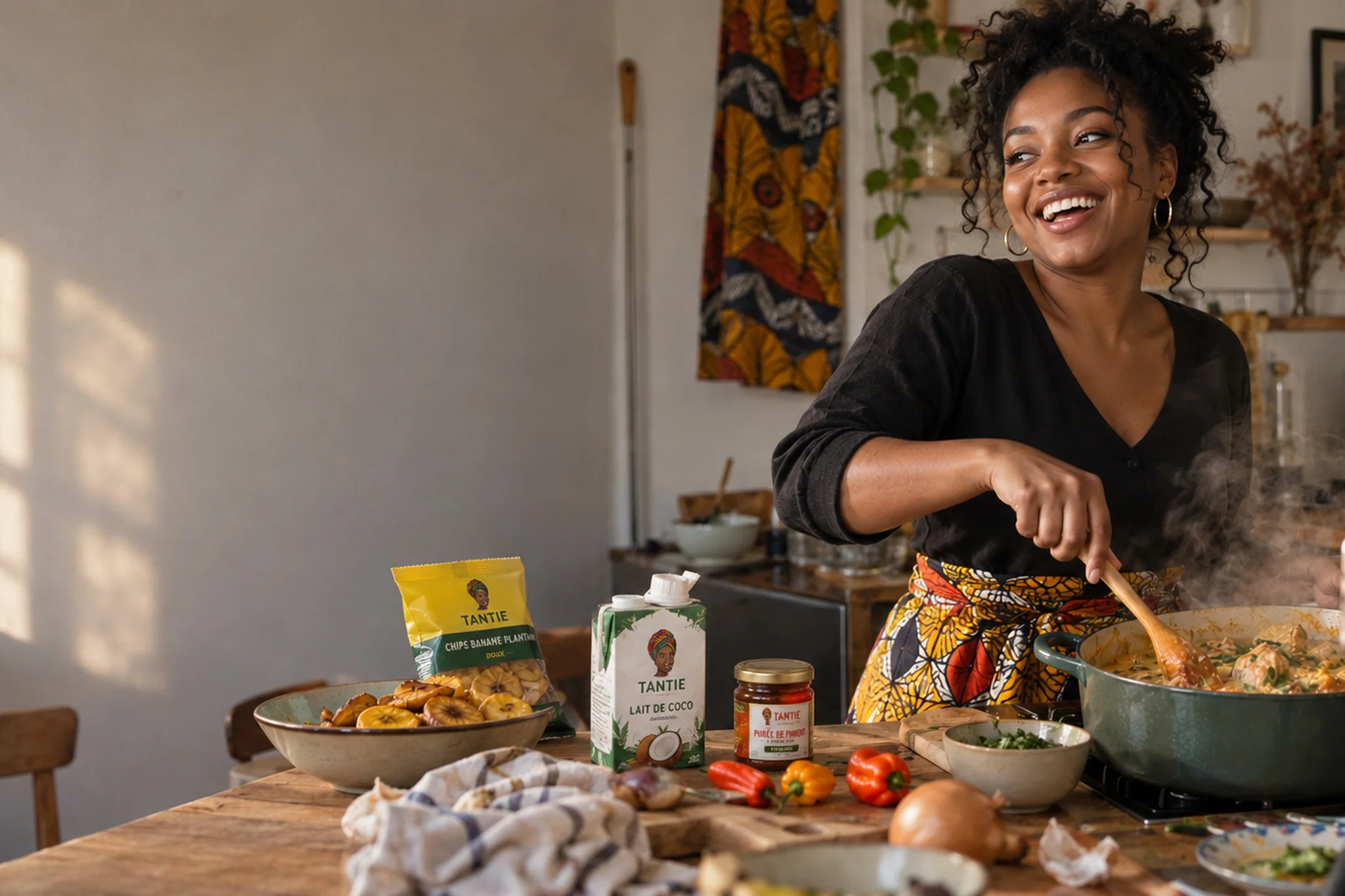
Culinary creators cooked iconic African dishes using Tantie products, sharing the personal stories behind their recipes or creating inventive twists, co-published directly with the brand. A curated discovery box containing flagship products was also gifted to micro-creators, free to review them authentically. Activated creators included Niang Cook, Zara Food, and Aïssa Kitchen. A key lesson emerged: top-tier creators deliver top-of-funnel reach, while micro-creators drive deep engagement and trust.
Street-level content and cultural resonance
In parallel, the brand produced original on-the-ground street content: spontaneous blind tastings of plantain chips and on-the-street interviews about African football during the Africa Cup of Nations (AFCON). The football vox-pop recruited proportionally more followers than content with far higher vanity views: speaking the authentic cultural language of your community builds lasting affinity, not just passive reach.
Results: a loyal and highly engaged community
We successfully built a community of over 5,000 highly engaged and loyal followers around Tantie’s products and cultural narrative. Campaign content generated millions of views with engagement rates exceeding direct competitors, including players established for decades. Strategic creator selection based on geographical audience location ensured that over 75% of the community resides in France, eliminating cross-border audience waste.
Above all, consumer sentiment spoke volumes. Feedback has been overwhelmingly positive—especially regarding the quality of the coconut milk and chili puree—with consumers spontaneously sharing their recipes in stories. The most frequent question received was simple: "Where can I buy the products in store?" The clearest proof of genuine consumer demand.
What the Tantie case study signals for 2027 food marketing trends
Tantie’s successful launch is not merely an isolated social media win. At a brand level, it validates five overarching structural shifts reshaping food marketing across France and Europe heading into 2027.
1. Authority shifts from brands to creators
For 2027, Mintel projects a decisive shift of authority toward individuals capable of informing, reassuring, and connecting amid information overload (Mintel, October 2026). In France, 38% of consumers have already prepared a recipe seen on social media within the year, and 23% purchased a viral food item; among 18-24 year-olds, 88% have taken at least one of these actions (OpinionWay for SIAL Paris). For Tantie, creator-led recipe videos generated the highest audience volumes. The recipe becomes the natural gateway to the product, and the culinary creator acts as the ultimate trusted prescriber.
2. Growth comes from communities, not generic mass markets
Mintel terms this the "Segmentation Reset": evolving lifestyles and diverse household structures mean consumer demand is fragmenting into hyper-specific needs. A brand that understands community culture fosters emotional attachment, not just momentary views. Tantie’s street interview during AFCON proved that culturally aligned content drives higher conversion to loyal followers. Diasporas—much like senior demographics who represent over a fifth of the French population yet remain neglected by mainstream advertising (Circana, SIAL Insights)—strongly reward brands that genuinely speak their language.
3. Engagement is the ultimate brand armor
When 53% of French shoppers are ready to switch food brands for a promotional discount (BCG), vanity reach is no longer enough: what matters is brand bond. Tantie demonstrated this: micro-creator content generated the highest engagement rates of the entire campaign, outperforming much larger legacy competitors. In 2027, challenger brands will build brand preference far faster than broad awareness, provided they track the metrics that truly matter.
4. Retail availability becomes a primary marketing mandate
Approximately 70% of new FMCG product launches still fail within their first year, predominantly due to poor shelf availability and discoverability (Kantar, SIAL Insights). Growth retail channels are local convenience stores and click-and-collect drive formats (~5% expected growth in 2026), while e-commerce already accounts for 13.3% of FMCG spending (NielsenIQ). Yet ethnic products frequently remain confined to peripheral hypermarket displays (Xerfi). With Tantie, the community’s primary inquiry was where to purchase. In 2027, influencer-driven demand must connect seamlessly with retail availability at the exact moment intent is sparked.
5. Generative AI models become everyday shopping advisors
In France, 20% of consumers have already consulted an AI tool to prepare a purchase, with 89% choosing ChatGPT, Gemini, or Perplexity (Shopfully via CB News, July 2026). These answer engines rely on factual, authoritative, and pervasive web references. Tantie’s indexed recipes, creator reviews, and social footprints systematically link the brand to specific dishes (ngalakh, coconut chicken, mafé). Transparency also counts: 54% of French consumers prioritize clean labels without artificial ingredients (BCG)—a cultural brand has every incentive to articulate its story and ingredients clearly, both for human consumers and for the AI agents advising them.
How to launch a food brand in 2027
The Tantie case study demonstrates that a modern food launch strategy relies on three indispensable pillars: creators chosen for their distinct funnel roles (awareness, interest, engagement), a deep cultural understanding of the target community, and an omni-channel distribution strategy that matches sparked demand. In isolation, each lever fails: viral reach without engagement is quickly forgotten, an engaged community unable to find the product churns, and a great product without a cultural voice remains unnoticed on crowded shelves. In an industry where margins leave zero room for error, a specialized agency combining influencer strategy, multicultural marketing, and retail activation—like ICS Agency—delivers decisive impact: uniting brands and their communities online and on the ground.
Planning a food brand launch or structuring your 2027 marketing strategy? Get in touch with the ICS Agency team to engineer your next campaign.
Key Takeaways
- Since December 2025, Tantie has generated millions of views across TikTok and Instagram, assembling a community of over 5,000 engaged, loyal followers.
- Multiple tailored influence formats were activated within the African community alongside top culinary creators including Niang Cook, Zara Food, and Aïssa Kitchen.
- Macro-creators deliver massive awareness; micro-creators unlock exceptional engagement and UGC trust.
- Tantie’s engagement rate outperformed direct competitors, including multi-decade legacy brands.
- The campaign validates five 2027 food marketing trends: creator authority, community-driven growth, engagement as defense, retail discoverability, and AI prescribers.
Executive Summary
Millions of views and an engaged community of over 5,000 food enthusiasts: with ICS Agency, Tantie launched its African food brand by leveraging culinary influence and community-first storytelling. Discover the methodology and how it anticipates 2027 food marketing trends.
Frequently Asked Questions (FAQ)
What is Tantie?
An authentic African food brand (coconut milk, plantain chips, chili puree, gari), launched across TikTok and Instagram in December 2025 alongside ICS Agency. In just a few months, it generated millions of impressions and built a community of 5,000+ loyal consumers.
How do you launch a food brand on social media?
By combining complementary funnel concepts: recognized culinary creators for broad awareness, co-published recipe content for consideration, and micro-creators for peer trust and high engagement. This multi-layered strategy enabled Tantie to beat industry engagement benchmarks.
Micro vs. macro influencers: which is best for food brands?
Both, allocated to specific funnel roles. For Tantie, top-tier creators provided mass reach and awareness, while micro-creators produced authentic user-generated content and the campaign’s highest engagement rates.
What are the defining food marketing trends for 2027?
Authority shifting to creators, community-led growth (Mintel’s "Segmentation Reset"), high engagement as a defense against price sensitivity, unified omnichannel availability, and the rise of Generative AI search engines as active purchase advisors.
Does social media genuinely drive food purchasing decisions?
Yes: 52% of French consumers say social networks directly influence their food choices, 38% cooked a recipe discovered online in the past year, and 23% bought a viral food product (OpinionWay for SIAL Paris).
Referenced Sources
- ICS Campaign Review « Tantie, Social Media Launch Report », July 17, 2026 (Internal Document) — campaign performance metrics, competitor audit, and community demographics.
- ANIA via Terre-net — industry turnover and net margins across the French food manufacturing sector.
- OpinionWay for SIAL Paris, via FreshPlaza — social media influence on French food consumption and purchasing patterns.
- NielsenIQ, FMCG Economic Outlook 2025 — market scale, promotional intensity, e-commerce, and drive-through retail shares.
- FranceAgriMer, Consumer Point May 2026 — volume dynamics of private labels vs. national brands (Circana data).
- BCG, Consumer Priorities 2026 — brand-switching propensities and clean-label expectations.
- Xerfi, Ethnic and World Food Market — world food aisle volume and supermarket distribution dynamics.
- INSEE, Immigrants and Descendants — diaspora population metrics from Sub-Saharan Africa.
- Mintel, Global Food and Drink Predictions 2027 — « Authority Shifts » and « Segmentation Reset » trends.
- SIAL Insights — FMCG launch failure rates (Kantar) and demographic weighting.
- Shopfully via CB News — consumer usage of generative AI tools for purchase preparation.
You might also like
- Street Marketing & Experiential
 Insights & Perspectives
 Insights & Perspectives